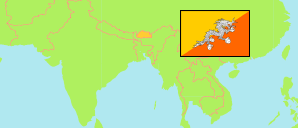
Punakha
District in Bhutan
Contents: Subdivision
The population development in Punakha as well as related information and services (Wikipedia, Google, images).
 icon links to further information about a selected division including its population structure (gender, age groups, age distribution, urbanization).
| Name | Status | Population Census 2005-05-31 | Population Census 2017-05-30 | |
|---|---|---|---|---|
| Punakha | District | 23,462 | 28,740 | |
| Barp (Bapisa) [← Thimphu District] | Gewog | 3,326 | 5,726 | → |
| Chhubu | Gewog | 1,991 | 1,651 | → |
| Dzomi (Dzoma) | Gewog | 1,350 | 2,147 | → |
| Goenshari | Gewog | 622 | 694 | → |
| Guma | Gewog | 6,580 | 9,014 | → |
| Kabisa (Kabjisa) | Gewog | 2,361 | 2,542 | → |
| Lingmukha | Gewog | 597 | 1,018 | → |
| Shelnga-Bjemi (Shengabjimi) | Gewog | 1,257 | 1,003 | → |
| Talog (Talo) | Gewog | 1,594 | 1,205 | → |
| Toedpaisa (Toepisa) [← Thimphu District] | Gewog | 2,421 | 2,427 | → |
| Toedwang (Toewang) | Gewog | 1,363 | 1,313 | → |
| Druk Yul [Bhutan] | Kingdom | 634,982 | 727,145 |
Source: National Statistics Bureau, Royal Government of Bhutan (web).
Explanation: The population figures of towns and municipalities are generally assigned to an adjacent gewog. Area figures of gewogs are computed by using geospatial data.
Further information about the population structure:
| Gender (C 2017) | |
|---|---|
| Males | 15,079 |
| Females | 13,661 |
| Age Groups (C 2017) | |
|---|---|
| 0-14 years | 7,364 |
| 15-64 years | 19,547 |
| 65+ years | 1,829 |
| Age Distribution (C 2017) | |
|---|---|
| 0-9 years | 4,541 |
| 10-19 years | 6,437 |
| 20-29 years | 5,860 |
| 30-39 years | 4,283 |
| 40-49 years | 2,879 |
| 50-59 years | 2,067 |
| 60-69 years | 1,417 |
| 70+ years | 1,256 |
| Urbanization (C 2017) | |
|---|---|
| Rural | 21,694 |
| Urban | 7,046 |